 upfix.com
 888-979-9343
Repair Is Resourcefulness: A Better Way to Use What We Already Own

Sustainability is often presented as a sacrifice: spend more, wait longer, accept less convenience, or change the way you live.
Repair offers a different model.
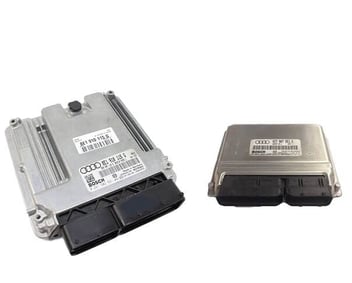
When an electronic module or control board can be restored responsibly, the financially practical choice and the environmentally responsible choice can be the same decision.
The customer keeps more of what is already working. The larger vehicle or machine stays in service. Fewer replacement materials are required. Less useful hardware is discarded.
Repair is not only conservation. It is resourcefulness.
Most failures are smaller than the systems they stop
A control board may weigh only a few pounds, yet its failure can threaten a vehicle, appliance, treadmill, or industrial machine that weighs hundreds or thousands of pounds.
The replacement economy treats the entire system as vulnerable to the smallest unsupported component. When the part is unavailable or expensive, the customer may be pushed toward replacing far more than the actual failure requires.
Repair-first thinking reverses the perspective:
- Keep the functioning structure.
- Keep the motors, housings, wiring, mechanics, and assemblies that remain useful.
- Investigate the electronic failure.
- Replace only what must be replaced.
- Test the restored unit.
- Return the larger system to productive use when possible.
That is one of the most direct forms of waste reduction available.
The first environmental benefit is avoided manufacturing
Recycling is important, but it happens after a product leaves service.
Repair can delay or prevent that disposal decision entirely. It also reduces demand for the materials, energy, packaging, transportation, and manufacturing required to produce a replacement.
The exact environmental impact varies by product and cannot be reduced to one universal number. A small board repair is different from a battery repair or an industrial drive. The responsible claim is simple: when a safe, durable repair keeps existing equipment in service, it avoids at least part of the replacement cycle.
The economic benefit makes the behavior scalable
People and businesses are more likely to choose sustainable options when those options also solve an immediate practical problem.
Repair can help:
- A family avoid replacing an appliance prematurely.
- A vehicle owner avoid a high module quote.
- A rebuilder finish a vehicle without losing the project's margin.
- A gym extend the life of expensive equipment.
- A manufacturer keep a proven machine running.
- An owner of older equipment work around obsolescence.
The customer does not need to choose between protecting the budget and reducing waste. The same repair can support both outcomes.
Repair preserves knowledge as well as materials
Older equipment often contains years of accumulated value that is not visible on a parts list.
The owner understands how it operates. Employees know how to use it. The business has procedures, tooling, spare parts, training, and maintenance history built around it. Replacing the system can require learning, reconfiguration, validation, installation, and new risks.
Repair can preserve that operational knowledge while restoring the component that failed.
Skilled repair work strengthens the service economy
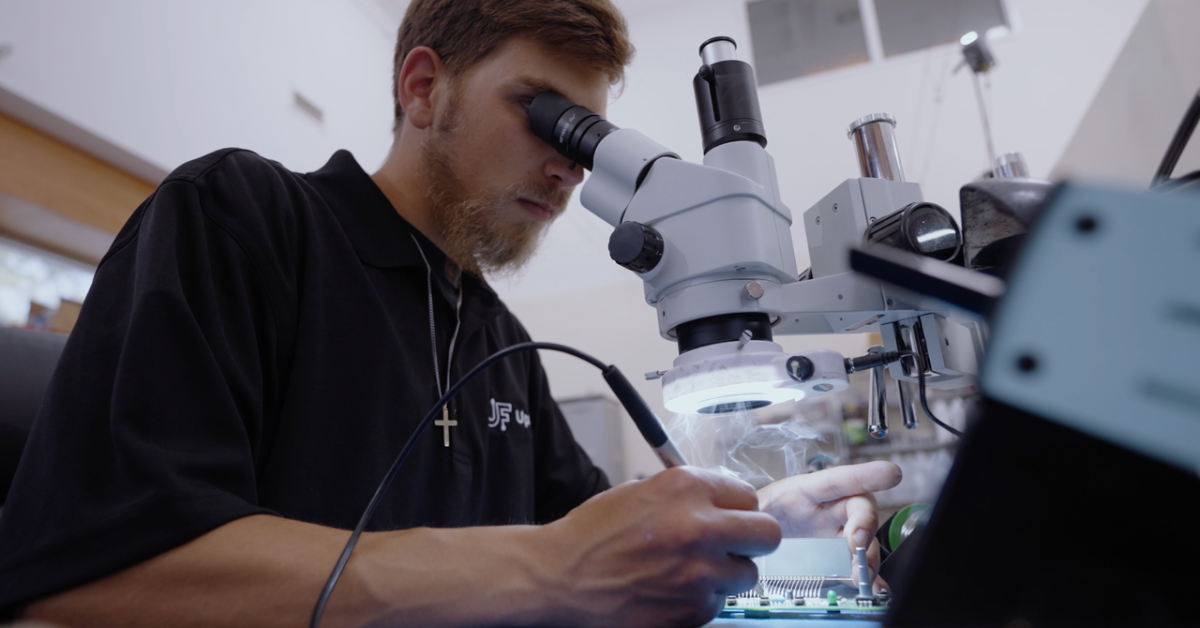
Component-level repair also depends on human expertise: diagnostics, soldering, programming, test development, circuit analysis, documentation, customer support, and continuous learning.
Those skills create value from hardware that the replacement economy may consider disposable.
The result is not nostalgia for old equipment. It is a more intelligent relationship with technology—one in which products are evaluated by their remaining useful life rather than the availability of the easiest replacement.
The numbers should represent real outcomes
UpFix currently publishes company-reported figures of more than one million parts serviced, more than 533,000 customers helped, over $363 million saved by customers compared with replacement, and more than 2.3 million pounds kept out of landfills.
Before those figures are used in campaigns, their methodology and current totals should be reviewed internally. When verified, they can make the repair-first impact tangible.
The strongest story is not the size of the number by itself. It is what each unit represents:
A customer kept an asset.
A business protected its budget.
A machine returned to work.
A replacement was avoided.
Useful electronics received another life.
Repair is not a step backward from innovation. It is innovation applied to what we already own.
Before replacing a vehicle module, appliance board, fitness controller, or industrial electronic, evaluate whether the original part can be repaired and returned to service.